Friday, March 2, 2012

(Dutch) Reformed Church in America Daily Prayer Request for Friday, 2 March 2012

From rca.org:


March 2 Prayer Request

Disability Awareness Sunday is celebrated on March 4. Pray for RCA churches that are being intentional about welcoming and accommodating people with disabilities and engaging them in ministry.
Today's Scripture: Mark 8:31-38

Mark 8:31-38

Jesus Foretells His Death and Resurrection

 Then he began to teach them that the Son of Man must undergo great suffering, and be rejected by the elders, the chief priests, and the scribes, and be killed, and after three days rise again. He said all this quite openly. And Peter took him aside and began to rebuke him. But turning and looking at his disciples, he rebuked Peter and said, ‘Get behind me, Satan! For you are setting your mind not on divine things but on human things.’
 He called the crowd with his disciples, and said to them, ‘If any want to become my followers, let them deny themselves and take up their cross and follow me. For those who want to save their life will lose it, and those who lose their life for my sake, and for the sake of the gospel, will save it. For what will it profit them to gain the whole world and forfeit their life? Indeed, what can they give in return for their life?Those who are ashamed of me and of my words in this adulterous and sinful generation, of them the Son of Man will also be ashamed when he comes in the glory of his Father with the holy angels.’


From Turning the Wheel of Truth: Commentary on the Buddha's First Teaching

From Tricycle:

From Turning the Wheel of Truth: Commentary on the Buddha's First Teaching


Ajahn Sucitto

When there is understanding and a set of values that encourage sharing, then the limitations, the needs, and the lacks of any given life can be acknowledged and effort can be put into using material supports with compassion.  This is also true in cases of deprivation; surely a major contributor to this is the greed and exploitation of others, which has its source in identification with material prosperity. If we could all accept the experience of limitation on our resources and comforts, if affluent people’s standard of living were not so high, there would be fewer people who felt, and actually were, “poor.” Maybe with more sharing, there would be less severe physical deprivation. Instead of creating golf courses in the desert, or seeing air-conditioning, two cars, and countless television channels as necessities of life, we could try to accept limitations to our material circumstances and acknowledge the there is suffering.
This acknowledgment doesn’t require that everyone should feel wretched; rather, it’s a matter of learning to know and accept that this earthly realm is one of limitation. When we wake up to how human life on this planet actually is, and stop running away or building walls in our heart, then we develop a wiser motivation for our life. And we keep waking up as the natural dukkha [suffering] touches us. This means that we sharpen our attention to catch our instinctive reactions of blaming ourselves, blaming our parents, or blaming society; we meditate and access our suffering at its root; and consequently we learn to open and be still in our heart. And even on a small scale in daily life situations, such as when we feel bored or ill at ease, instead of trying to avoid these feelings by staying busy or buying another fancy gadget, we learn to look more clearly at our impulses, attitudes, and defenses. In this way dukkha guides and deepens our motivation to the point where we’ll say, “Enough running, enough walls, I’ll grow through handling my blocks and lost places.”

Excerpted from Turning the Wheel of Truth by Ajahn Sucitto, © 2010. Published by arrangement with Shambhala Publications, Inc., Boston. www.Shambhala.com.

(Dutch) Reformed Church in America Lent Devotions for Thursday, 1 March 2012

From rca.org:


Posted: 29 Feb 2012 05:53 AM PST
It's often not easy to open your heart and mind to the wonders that God has in store for you. When I reflect on Abraham's complete trust and faith in following God's calling, I am reminded of a colleague of mine who had it put upon her heart to go into the ministry. She had always been strong in her faith, but she still couldn't quiet the small voices in her head that began to weigh this call from God in human terms. How could she possibly go to seminary? She had two small children, worked full-time, and had a husband who also worked and was finishing his degree. Where would she find the time and energy? Even if she studied part time, it would take five years to get a master of divinity, and by then she would be past forty. Did that make any sense?
Now, it's not easy being human, but my colleague knew that her faith had never failed her, so she used the spiritual practices that Jesus himself had used during his ministry. She prayed and discerned and spoke to others who had taken the journey before her, and then she stepped back and let God have the final say.
Today she is over forty with a master of divinity degree. Her daughters are growing into fine little people. Her husband has his master's degree and their marriage is solid. And her faith? Her faith is stronger than ever as she walks proudly down the promised road to ordination, bathed in the light and love of Jesus Christ.
Colleen Cosgrove, member of Marble Collegiate

Thursday, March 1, 2012

American Bible Society Lectio Divina for Sunday, 4 March 2012

From The American Bible Society:


March 4, 2012
Second Sunday of Lent
This is a reminder to continue in your daily Lectio Divina Scripture reading. We’ve included the content again for you, to make it easier for you to continue to engage with God’s Word.

THIS IS MY OWN DEAR SON: LISTEN TO HIM!

Mark 9:2-10 (Good News Translation)
2 Six days later Jesus took with him Peter, James, and John, and led them up a high mountain, where they were alone. As they looked on, a change came over Jesus, 3 and his clothes became shining white—whiter than anyone in the world could wash them. 4Then the three disciples saw Elijah and Moses talking with Jesus. 5 Peter spoke up and said to Jesus, “Teacher, how good it is that we are here! We will make three tents, one for you, one for Moses, and one for Elijah.” 6 He and the others were so frightened that he did not know what to say. 7 Then a cloud appeared and covered them with its shadow, and a voice came from the cloud, “This is my own dear Son—listen to him!” 8They took a quick look around but did not see anyone else; only Jesus was with them. 9As they came down the mountain, Jesus ordered them, “Don't tell anyone what you have seen, until the Son of Man has risen from death.” 10 They obeyed his order, but among themselves they started discussing the matter, “What does this “rising from death” mean? ”

Lectio

As on so many other occasions, today’s Gospel must be set in its context in order to grasp what Jesus’ mission and person meant, as well as the consequences and implications it had in the life of the disciples. Prior to this event, the three Synoptic Gospels show Jesus asking the disciples what the crowds, and they themselves, think about him. It is clear that, according at least to Peter’s solemn statement , “You are the Messiah” (Mark 8:29), they are certain that he is not just another rabbi or some common preacher of the moment Anyhow, Jesus notices that they have not understood what the title and reality of the word “Messiah” meant for him. In fact, their “thoughts don’t come from God but from human nature” (8:33), for they still share the common opinion of the people: the Messiah will be the powerful king who will fulfil the old promises, defeat the Romans and set Israel free from foreign rule, just as any other political and religious leader would do. Jesus, then, tries to explain his plans. He will not use worldly force or power, but will subject his own will to the Father’s and assume the role of the Suffering Servant. It is through his death that he will redeem Israel and all nations. Even so, they do not understand his teaching about that unexpected way to fulfil his messianic mission. Nor can they accept his words about the way in which they must follow him: carrying the cross, losing one’s life for him and for the Gospel? So confused were they, that “they were afraid to ask him” (9:32). In that context, full of fear, pessimistic thoughts and unacceptable projects, the vision of Jesus on the top of the mountain (a place fit for Moses and Elijah, as both of them had been close to God on Mount Sinai) is a breath of fresh air, a gleam of light, a moment of relief and solace. Although they may not understand the meaning of Jesus’ suffering (or their own self-denial for the Gospel’s sake); even if they still cannot grasp what “rising from death meant;” no matter how frightened they might be, Christ‘s glorious presence, transfigured in his shining clothes, was a foreshadowing of his resurrection and a foretaste of his confirmation as the Messiah of Israel. There is, besides, another important point in the story: the voice from heaven. Just as in his baptism, God’s voice ratifies and proclaims Jesus as his dear, chosen Son; but on this occasion, there is something new, a message for the disciples. Even if you have doubts, even if you are afraid, be sure that he is the one who was promised to come: “Listen to him!” Today’s liturgy provides us with another reassuring message, addressed especially to us who live so far away from Christ in time and history. We may perhaps share the apostles’ doubts and fears; we may feel confused and afraid like Abraham in front of the sacrifices demanded from us; we may be accused, or have things or people against us. No matter what may happen, we know for sure that nothing or no one will be able to separate us from God the Father, who gave us his Son.

Meditatio

When we think of Abraham and the terrible test he was subjected to, and compare it with our own trials and tests, we must admit that we are far from the demands he had to face. Even if there is no comparison, have you ever been put to a serious test in your Christian life? If so, how did you cope with it? It may seem repetitive, but we must recall once again the deep crisis of our present society. In what ways can we contribute to a real “transfiguration” of unjust and oppressive situations? How can we show the “shining clothes” of Christian hope to those who live in despair?

Oratio

When we face the harsh path we must take to follow Christ, or when we recognize the failures and shortcomings in our Christian life, our lack of fidelity to his words, we often feel dismayed and disheartened. Let us pray today for the whole Church: that we may reach the conviction that nothing in heaven or earth –not even our failures or sins- can separate us from God’s love.

Contemplatio

Recite, in calm and quietness, Psalm 27: “The Lord is my light and my salvation…” As you have on other occasions, choose a couple of verses which can be your spiritual “motto” during the week.
Reflections written by Rev. Fr. Mariano PerrĂ³n Director of Inter-Religious Affairs Archdiocese of Madrid, Spain
© 2010 American Bible Society. 

Catholic Liturgical Year: Lent--Thursday, 1 March 2012

From CatholicCulture.org:


The most comprehensive treatment of the Liturgical Year available online: daily reflections, saints, seasons, calendars, prayers, activities, and recipes.

Daily Readings for:March 01, 2012
(Readings on USCCB website)

Collect: Bestow on us, we pray, O Lord, a spirit of always pondering on what is right and of hastening to carry it out, and since without you we cannot exist, may we be enabled to live according to your will. Through our Lord Jesus Christ, your Son, who lives and reigns with you in the unity of the Holy Spirit, one God, for ever and ever.

Lent: March 1st

FacebookTwitterThursday of the First Week of LentOld Calendar: Wales and England: St. David; St. Albinus, bishop (Hist)
Move to: Previous Day | Next Day
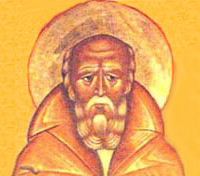
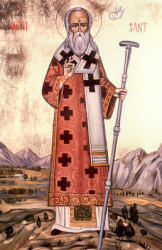
Today the Church in Wales and England celebrates the feast of St. David, bishop and patron of Wales. Very little is known about the life of St. David (Dewi Sant). He belonged to that great monastic movement which became influential in Wales in the sixth century and which had links with monasticism in Gaul and in Ireland. The earliest references to David are in the Irish Annals. Many churches across South Wales claim David as their founder. His chief foundation was at Mynyw or Menevia in Dyfed. He was canonized by Pope Callistus II in 1123.
Historically today is the feast of St. Albinus, bishop and miracle worker, also known as Aubin.

St. David
All the information we have about David is based on the unreliable eleventh-century biography written by Rhygyfarch, the son of Bishop Sulien of St. David's. According to it David was the son of King Sant of South Wales and St. Non, became a priest, studied under St. Paulinus on an unidentified island for several years, and then engaged in missionary activities, founding some dozen monasteries, the last of which, at Mynyw (Menevia) in southwestern Wales, was noted for the extreme asceticism of its rule, which was based on that of the Egyptian monks. David attended a synod at Brefi, Cardiganshire, in about 550 where his eloquence is said to have caused him to be elected primate of the Cambrian Church with the understanding that the episcopal see would be moved from Caerleon to Mynyw, now St. David's. He was supposedly consecrated archbishop by the patriarch of Jerusalem while on pilgrimage to the Holy Land, and a council he convened, called the Synod of Victory because it marked the final demise of Pelagianism, ratified the edicts of Brefi, and drew up regulations for the British Church. He died at his monastery at Mynyw, and his cult was reputedly approved by Pope Callistus II about 1120. Even his birth and death dates are uncertain, ranging from c. 454 to 520 for the former and from 560 to 601 for the latter.
Excerpted from Dictionary of Saints, John J. Delaney

St. Albinus
Albinus was born into an ancient and noble family in Brittany. He was a pious child and when he was still young he entered the monastery of Tintillant against the wishes of his parents. Albinus embraced the austerities of monastic life and accepted doing the most humble chores without complaining.
His burning desire was to live for Christ. Respected by the other monks for setting a good example and his devotion to prayer. Albinus was elected abbo9t when he was just 35. The monastery flourished under his modest Rule, and the monks at Tintillant were enriched by his wisdom. In 529, after serving 25 years as abbot, Albinus was named Bishop of Angers. Although his opinions were now sought by royalty, his manner remained unpretentious.
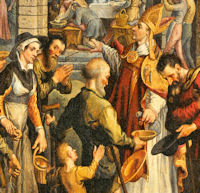
As bishop, Albinus worked for the greater good of his people, instructing them in their faith. With the support of King Childebert, he convened two councils at Orleans that condemned the incestuous marriages of many powerful families. When his diocese was raided by pagan invaders and countless citizens were taken into slavery, Albinus made very effort to ransom them while giving generously to the sick and the poor.
Many miracles were attributed to Albinus. According to one story, when he was unable to procure the release of some badly treated prisoners, he prayed in front of the prison until a landslide destroyed it, allowing the men to escape. They then reformed and became model Christians and citizens. After the death of Albinus, the abbey of St. Albinus was built over his grave at Angers and became a popular place of pilgrimage.
Excerpted from "Ordinary People Extraordinary Lives"

The Station today is at St. Lawrence in Panisperna. The church stands on the site of St. Lawrence's martyrdom. The appellation refers to the name of the street, which in turn most likely refers to the tradition of the Poor Clares in the adjacent convent of distributing bread and ham (pane e perna) on August 10th, the feast day of St. Lawrence. This is done in remembrance of St. Lawrence distributing funds from the church to the poor. 

American Bible Society Daily Bible Reading and Daily Prayer for Thursday, 1 March 2012

From The American Bible Society:


Psalm 84(Good News Translation)

Come Together in Faith and Pray for One Another

Introduction

Psalm 84: For the entire month of March we will be reading from the book of Psalms, the hymnbook and prayer book of the Bible. The psalms express a broad spectrum of human emotions – sorrow and joy, doubt and trust, pain and comfort, despair and hope, anger and contentment, a desire for revenge and a willingness to forgive. The psalms serve as models for praise and prayer, inviting us to share every part of our lives with God. We begin today with Psalm 84, a psalm that celebrates the joy of being and living in God’s presence.

Today's Scripture: Psalm 84:2b

I long to be in the LORD’s Temple. With my whole being I sing for joy to the living God.

Today's Reading

1 How I love your Temple, LORD Almighty! 2 How I want to be there! I long to be in the LORD's Temple. With my whole being I sing for joy to the living God. 3 Even the sparrows have built a nest, and the swallows have their own home; they keep their young near your altars, 4 How happy are those who live in your Temple, always singing praise to you. 5 How happy are those whose strength comes from you, who are eager to make the pilgrimage to Mount Zion. 6 As they pass through the dry valley of Baca, it becomes a place of springs; the autumn rain fills it with pools. 7They grow stronger as they go; they will see the God of gods on Zion. 8 Hear my prayer, LORD God Almighty. Listen, O God of Jacob! 9 Bless our king, O God, the king you have chosen. 10 One day spent in your Temple is better than a thousand anywhere else; I would rather stand at the gate of the house of my God than live in the homes of the wicked. 11 The LORD is our protector and glorious king, blessing us with kindness and honor. He does not refuse any good thing to those who do what is right. 12 LORD Almighty, how happy are those who trust in you!

Reflect

How many times does the word “happy” appear in this psalm? What brings about this happiness? What makes you happy? How is happiness experienced in your community of faith?

Pray

Almighty God, with my whole being I sing for joy and praise your holy name. You are my source of strength, and my joy comes from trusting in you. Amen.

Prayer Concern

Worship leaders

(Dutch) Reformed Church in America Daily Prayer Request for Thursday, 1 March 2012

From rca.org:


March 1 Prayer Request

On March 1, Koreans commemorate their nation's resistance against Japanese occupation in the early 20th century. Pray that God will bring continued healing and reconciliation between Japan and Korea, and that RCA mission partners like the United Church of Christ in Japan (Kyodan)and the Presbyterian Church of Korea will be gospel witnesses and leaders in reconciliation.
Today's Scripture: Romans 4:16-25


Romans 4:16-25

 For this reason it depends on faith, in order that the promise may rest on grace and be guaranteed to all his descendants, not only to the adherents of the law but also to those who share the faith of Abraham (for he is the father of all of us, as it is written, ‘I have made you the father of many nations’)—in the presence of the God in whom he believed, who gives life to the dead and calls into existence the things that do not exist. Hoping against hope, he believed that he would become ‘the father of many nations’, according to what was said, ‘So numerous shall your descendants be.’ He did not weaken in faith when he considered his own body, which was already as good as dead (for he was about a hundred years old), or when he considered the barrenness of Sarah’s womb. No distrust made him waver concerning the promise of God, but he grew strong in his faith as he gave glory to God, being fully convinced that God was able to do what he had promised. Therefore his faith ‘was reckoned to him as righteousness.’ Now the words, ‘it was reckoned to him’, were written not for his sake alone, but for ours also. It will be reckoned to us who believe in him who raised Jesus our Lord from the dead, who was handed over to death for our trespasses and was raised for our justification.