
From: P. Teodor Puszcz SChr
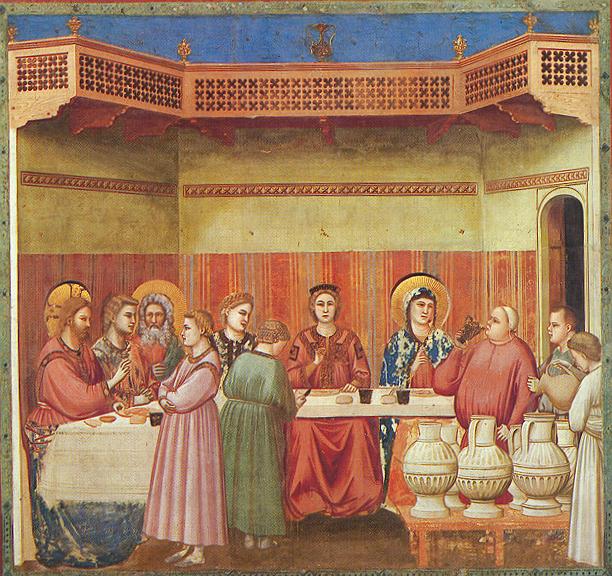
Die Hochzeit zu Kana
Fresko von Giotto di Bondone (1267-1337),
Arenakapelle in Padua.
Quelle: L. Bellosi. Giotto. Florenz 2003, S. 47.
The Wedding at Cana
Von fresco of Giotto di Bondone (1267-1337),
Arenakapelle in Padua.
Source: L. Bellosi. Giotto. Florence 2003, p. 47
2. Sonntag im Jahreskreis
Am zweiten Sonntag im Jahreskreis stellt die Kirche im Mittelpunkt ihrer Liturgie die Beschreibung des ersten Zeichens aus dem Evangelium nach Johannes. Nur dieser Evangelist berichtet über das Wunder Jesu während der Hochzeit zu Kana (Joh 2, 1-11). Für ihn ist das das erste der sieben Zeichen in seinem Evangelium. Giotto di Bondone (1267-1337), der sich als ausgezeichneter Freskenmaler in verschiedenen Städten Italiens den Namen machte, hat 1305-1306 in der Arenakapelle in Padua (Capella degli Scrovegni) Bilderzyklen zum Leben Jesu, Jungfrau Maria und ihrer Eltern gemalt. Unter den 38 Fresken befindet sich auch ein Bild mit der Hochzeit zu Kana. Auf den Ernst vorhergehenden Szenen folgt mit der Hochzeit zu Kana eine erfrischende Ruhepause. Der eingehend geschilderte Innenraum mit seinen Wandbehängen, die dickbäuchigen Weinkrüge, die Knechte mit ihren komischen Gesichtern, die fast zum Lachen reizen, geben dem Ganzen eine unbeschwert fröhliche Stimmung, die in den folgenden drei Szenen allerdings sogleich wieder größerer Würde weicht. Jesus sitzt ganz abseits am Tisch. Zu seiner Linken zwei Jünger, weiter der Bräutigam und die Braut, ausgezeichnet mit Kopfschmuck und festlicher Kleidung. Neben der Braut sitzt Maria, die mit dem Gesicht und dem Zeigegestus sich dem Gastwirt zuwendet. Zwei Diener neben ihm sind mit dem Abfüllen der Krüge beschäftigt. Zwei weiteren sind links im Bild zu sehen, der eine hört Jesus zu und der andere bedient das Brautpaar.
Ein orientalisches Hochzeitsfest dauerte drei, manchmal aber auch vier bis sieben Tage und Nächte lang. Die Männer saßen in einer Reihe nebeneinander am Boden, entsprechend ihrem Alter und ihrer gesellschaftlichen Stellung. Die Frauen befanden sich ihnen gegenüber und formten einen Kreis. Musiker und Diener hatten ihren Platz nahe bei der Haustüre. Ein üppiger Hochzeitsschmaus wurde vom Bräutigam angeboten. Die Nachbarn bereiteten besonders beliebte Gerichte als ihre Gaben an das Brautpaar. Für den Wein sorgten die Gäste. Die Gäste gaben der Reihe nach den Dienern Auftrag, den Wein herbeizuschaffen. Beim Ausschenken des Getränks erwähnten die Diener jeweils den Namen des Spenders. Alle tranken dann auf die Gesundheit und das Glück des Brautpaars. Jeder Gast war verpflichtet, seinen Teil zum guten Gelingen des Festes beizutragen. Jeder Gast hielt es für seine Ehre und Pflicht, dem Bräutigam seine Freundschaft zu beweisen. Nach der östlichen Etikette durfte ein Gast aber nur dann einen Diener Auftrag geben, neuen Wein herbeizubringen, wenn die Reihe an ihm war. Eine Bestellung außer der Reihe zwischendurch, auch nur irrtümlicherweise, wurde dem Gast sehr übel genommen. Ein derartiges Abweichen von der überlieferten Sitte würde auch von den Besuchern als eine Beleidigung empfunden. Bei dieser Hochzeit saß Maria in einer Gruppe der Frauen, schaute aber immer zu ihrem Sohn hinüber, dem einzigen nüchtern Gebliebenen unter all den Männern. Sie sagte zu ihm, der östlichen Fassung des Textes nach: der Wein hatte abgenommen (Joh 2, 3). Jesus antwortete ihr: Meine Stunde ist noch nicht gekommen (Joh 2, 4). Das aramäische Wort shaa heißt Stunde, Zeit und Reihe und muss im vorliegenden Vers als die Reihe an mir interpretiert werden. Jesus bezog sich auf die Gewohnheit des gastlichen Bewirtens. Offensichtlich war er noch nicht an die Reihe gekommen, um seinen Beitrag zu leisten. Maria vermutete offenbar, es sei jetzt der Moment für Jesus gekommen, die Gesellschaft zu bewirten. Sie wandte sich an die in ihrer Nähe stehenden Diener und flüsterte ihnen zu, sie sollten tun, was er ihnen auftragen werde (vgl. Joh 2, 5). Maria dachte nicht im entferntesten daran, Jesus werde ein Wunder wirken. Bisher hatte ihr Sohn noch keine getan. Die Mutter war daher von allen weitaus am meisten überrascht und erfreut, als sie hörte, wie die Gäste das Getränk, das Jesus ihnen vorsetzen ließ, als das beste von allen bisherigen rühmten. Die Gäste hatten erwartet, aus den Krügen, welche die Diener auf Geheiß Jesu mit Wasser füllten, nichts anderes als Wasser eingeschenkt zu bekommen. Wenn Männer, die sich ganz der geistigen Tätigkeit widmen, wie Jesus auch, Festlichkeiten beiwohnten, lehnten sie es nicht nur ab, Wein für die Gäste zu kaufen, sondern ermahnten die Teilnehmer auch, mit dem Trinken aufzuhören. Das führte oft zu Völlerei, Streit, Mord und Totschlag. Jeder derartige Mann schlug immer den Gebrauch von Wasser vor. Jesus in Kana hat sich zuerst auch so verhalten, als er die Krüge mit Wasser füllen ließ. Er behob den Mangel an Wein dadurch, dass er den Gästen Wasser anbot und ihren Durst mit geistigem Wein löschte. Wasser ist das beste und kostbarste Getränk der Welt. Der Mensch kann ohne Wein leben, aber keine Kreatur das Wasser entbehren. Dieses erste Wunder Jesu hat geistige Bedeutung. Seine Lehre war die beste, welche die Galiläer bisher je zu kosten bekommen hatten.
Jesus, wecke in uns den Durst deines Getränks.
Jesus, fülle uns mit deiner Lehre.
Jesus, lösche in uns den Durst nach deiner Liebe.
2 Niedziela Zwykła
W drugą Niedzielę Zwykłą Kościół stawia w centrum swojej Liturgii opis pierwszego znaku z Ewangelii Janowej. Tylko ten Ewangelista opowiada o cudzie Jezusa podczas wesela w Kanie (J 2, 1-11). Dla niego jest to pierwszy z siedmiu znaków w jego Ewangelii. Giotto di Bondone (1267-1337), który zasłynął jako wyśmienity malarz fresków w różnych miastach włoskich, namalował w latach 1305-1306 w kaplicy na Arenie w Padwie (Capella degli Scrovegni) cykle obrazów opowiadające o życiu Jezusa, Panny Maryi i Jej rodziców. Wśród 38 fresków znajduje się obraz z weselem w Kanie. Powaga w poprzedzających scenach ustępuje miejsca ożywiającej pauzie w scenie wesela w Kanie. Szczegółowo przedstawione wnętrze z makatami, wybrzuszone dzbany na wino, słudzy z komicznymi minami, przyprawiającymi o śmiech, nadają całości beztroską i wesołą atmosferę. Ta z kolei od razu ustępuje miejsca ponownie wielkiej godności w następujących trzech scenach. Jezus siedzi przy stole całkiem z boku. Po Jego lewicy dwaj uczniowie, następnie oblubieniec i oblubienica, odznaczający się strojem i ozdobami na głowie. Obok oblubienicy siedzi Maryja, która zwraca się do starosty. Dwaj słudzy obok niego są zajęci napełnianiem dzbanów. Następnych dwóch widzimy z lewej strony obrazu, jeden z nich słucha Jezusa, a drugi obsługuje młodą parę.
Orientalne wesele trwało trzy, a czasami cztery do siedmiu dni i nocy. Mężczyźni siedzieli na ziemi w rzędzie obok siebie, odpowiednio do wieku i rangi społecznej. Kobiety natomiast znajdowały się naprzeciw nich i tworzyły koło. Muzycy i słudzy mieli swoje miejsce w pobliżu wyjścia. Wykwintna uczta weselna była przygotowana przez oblubieńca. Sąsiedzi przygotowywali ulubione potrawy jako dary dla młodej pary. Natomiast o wino troszczyli się goście. Owi goście po kolei dawali polecenie sługom, aby przynieśli wino. Podczas nazlewania wina słudzy wymieniali imię kolejnego ofiarodawcy. Wszyscy pili toast za zdrowie i szczęście zaślubionych. Każdy z gości był zobowiązany dołożyć swoją część, by uroczystość się udała. Każdy z gości uważał za honor i obowiązek, okazać w ten sposób swój szacunek i przyjaźń oblubieńcowi. Według wschodniej etykiety gość mógł dać polecenie słudze, aby przyniósł nowe wiono, dopiero wtedy, gdy przyszła na niego kolej. Zamówienie poza kolejką, także przez pomyłkę, było niemile widziane. Takie odstąpienie od panującego zwyczaju mogłoby przez gości być odebrane jako obraza. Podczas tego wesela Maryja siedziała w grupie kobiet i spoglądała stale w stronę swojego Syna, który jako jedyny z mężczyzn pozostał trzeźwy. Powiedziała Ona do Niego, według wschodniej wersji tekstu: ubyło już wina (J 2, 3). Jezus Jej odpowiedział: Moja godzina jeszcze nie nadeszła (J 2, 4). Aramejskie słowo shaa znaczy godzina, czas, kolejka i powinno w tym wersie być zinterpretowane jako moja kolejka. Jezus odniósł się tutaj do zwyczaju gościnności. Widocznie nie przyszła jeszcze Jego kolejka, aby dołożyć swoją część. Maryja przypuszczała, że teraz przyszedł odpowiedni moment dla Jezusa, aby ugościł towarzystwo. Zwróciła się Ona do sług stojących w pobliżu i szepnęła im, aby uczynili to, co im powie (por. J 2, 5). Maryja nie myślała wcale o tym, że Jezus uczyni cud. Do tej pory Jej Syn nie uczynił żadnego. Matka była chyba najbardziej z wszystkich zaskoczona i uradowana, kiedy goście napój podany przez Jezusa, pochwalili jako najlepszy z wszystkich dotychczas podanych. Goście spodziewali się, że z dzbanów napełnionych wodą na polecenie Jezusa, podadzą im nic innego jak tylko wodę. Gdy mężczyźni, oddani całkowicie duchowej działalności, podobnie jak Jezus, bywali na uroczystości, to nie tylko nie popierali kupna wina dla gości, ale upominali ich do zaprzestania picia, bo to często prowadziło do obżarstwa, sporów, mordów i zabójstw. Każdy człowiek tego typu proponował raczej spożywanie wody. Jezus w Kanie najpierw zachował się w ten sposób, gdy polecił dzbany napełnić wodą. Zaradził On brakowi wina przez to, że gościom zaproponował wodę i ich pragnienie ugasił duchowym winem. Woda jest najlepszym i najcenniejszym napojem na świecie. Człowiek bez wina może przeżyć, ale żadne stworzenie nie może obejść się bez wody. Ten pierwszy cud Jezusa ma duchowe znaczenie. Jego nauka była najlepszą z nauk, jakich Galilejczycy do tej pory zakosztowali.
Jezu, wzbudź w nas pragnienie Twojego napoju.
Jezu, napełnij nas Twoją nauką.
Jezu, ugaś w nas pragnienie Twojej miłości.
2. Sunday in Ordinary Time
On the second Sunday of Lent, the Church is in the heart of its liturgy, the description of the first character from the Gospel of John. Only this evangelist about the miracles of Jesus during the wedding at Cana (Jn 2, 1-11). For him, this is the first of the seven characters in his gospel. Giotto di Bondone (1267-1337), the frescoes to be an excellent painters in different cities of Italy made the name, has 1305-1306 in the Arena Chapel in Padua (Capella degli Scrovegni) painted pictures of life cycles of Jesus, Virgin Mary and her parents. Among the 38 frescoes is also a picture with the wedding at Cana. At Ernst previous scenes following the wedding at Cana, a refreshing break. Described in detail the interior with its tapestries, the spacious wine jars, the servants with their funny faces, the most irritating laugh, give the whole a happy carefree mood that differs in three scenes, but once again greater dignity. Jesus is sitting right off the table. To his left, two disciples on the groom and the bride, received headdresses and ceremonial clothing. In addition to the bride at Mary, who turns his face and the gesture of pointing to the innkeeper. Two servants find him employed on the filling of the jars. Two more are to be seen on the left, one hears of Jesus and the other served the couple.
An oriental wedding party lasted for three, sometimes four to seven days and nights. The men sat in a row next to each other on the ground, according to their age and social status. The women were against them and formed a circle. Musicians and servants had their place near the door. A sumptuous wedding feast was offered by the groom. The neighbors were preparing their most popular dishes as gifts to the bride and groom. For the wine provided the guests. The score gave the number for the services contract, procure the wine. When pouring the drink mentioned the name of the servant of each donor. Then all drank to the health and happiness of the bride and groom. Each guest was obliged to part to the success of the party to do its. Each guest of honor, and considered it his duty to prove his friendship with the groom. After the Eastern etiquette guest but only one was allowed to be a servant job, bring wine to bring new, if the series he was on. An order out of sequence in between, even accidentally, was highly resented the guest. Such a departure from the traditional custom of the visitors would also perceived as an insult. Mary sat at this wedding in a group of women, but always looked over at her son, the only one sober at heart among all the men. She said to him, the eastern version of the text by: the wine had lost (Jn 2, 3). Jesus replied: "My hour has not yet come (John 2, 4). The Aramaic word shaa means hour, time and number and must be in this verse as my turn to be interpreted. Jesus was referring to the custom of welcoming hospitality. Obviously he was not the series came in to make a contribution. Maria apparently suspected that it was now the moment for Jesus came to serve the society. She turned to the vicinity of their servants standing in and whispered to them, they should do what he would apply to them (cf. Jn 2, 5). Maria had not the remotest idea that Jesus would work miracles one. So far her son had still not done. The mother was so far the most surprising of all and pleased when she heard the guests drink set before them was Jesus, as the best of all previous glory. The guests had expected the pitchers who at the behest of Jesus filled with water, do not serve as water poured out to get something from. If men who devote themselves entirely to the intellectual activity, as Jesus also attended festivities, they rejected it just does not, to buy wine for the guests, but admonished the participants also quit drinking. This often leads to gluttony, strife, murder and manslaughter. Any such man banged against the use of water. Jesus at Cana was the first to so behave himself as he was filling with water jugs. He fixed the lack of wine in that it offered the guests water, and quenched their thirst with intellectual wine. Water is the best and most precious drink in the world. Man can live without wine, but the creature does not dispense water. This first miracle of Jesus has spiritual significance. His teaching was the best, which hitherto had ever gotten to taste the Galileans.
Jesus awakens in us the thirst of your beverage.
Jesus, fill us with your teachings.
Jesus, put out in us a thirst for your love.
Die Hochzeit zu Kana
Fresko von Giotto di Bondone (1267-1337),
Arenakapelle in Padua.
Quelle: L. Bellosi. Giotto. Florenz 2003, S. 47.
The Wedding at Cana
Von fresco of Giotto di Bondone (1267-1337),
Arenakapelle in Padua.
Source: L. Bellosi. Giotto. Florence 2003, p. 47
2. Sonntag im Jahreskreis
Am zweiten Sonntag im Jahreskreis stellt die Kirche im Mittelpunkt ihrer Liturgie die Beschreibung des ersten Zeichens aus dem Evangelium nach Johannes. Nur dieser Evangelist berichtet über das Wunder Jesu während der Hochzeit zu Kana (Joh 2, 1-11). Für ihn ist das das erste der sieben Zeichen in seinem Evangelium. Giotto di Bondone (1267-1337), der sich als ausgezeichneter Freskenmaler in verschiedenen Städten Italiens den Namen machte, hat 1305-1306 in der Arenakapelle in Padua (Capella degli Scrovegni) Bilderzyklen zum Leben Jesu, Jungfrau Maria und ihrer Eltern gemalt. Unter den 38 Fresken befindet sich auch ein Bild mit der Hochzeit zu Kana. Auf den Ernst vorhergehenden Szenen folgt mit der Hochzeit zu Kana eine erfrischende Ruhepause. Der eingehend geschilderte Innenraum mit seinen Wandbehängen, die dickbäuchigen Weinkrüge, die Knechte mit ihren komischen Gesichtern, die fast zum Lachen reizen, geben dem Ganzen eine unbeschwert fröhliche Stimmung, die in den folgenden drei Szenen allerdings sogleich wieder größerer Würde weicht. Jesus sitzt ganz abseits am Tisch. Zu seiner Linken zwei Jünger, weiter der Bräutigam und die Braut, ausgezeichnet mit Kopfschmuck und festlicher Kleidung. Neben der Braut sitzt Maria, die mit dem Gesicht und dem Zeigegestus sich dem Gastwirt zuwendet. Zwei Diener neben ihm sind mit dem Abfüllen der Krüge beschäftigt. Zwei weiteren sind links im Bild zu sehen, der eine hört Jesus zu und der andere bedient das Brautpaar.
Ein orientalisches Hochzeitsfest dauerte drei, manchmal aber auch vier bis sieben Tage und Nächte lang. Die Männer saßen in einer Reihe nebeneinander am Boden, entsprechend ihrem Alter und ihrer gesellschaftlichen Stellung. Die Frauen befanden sich ihnen gegenüber und formten einen Kreis. Musiker und Diener hatten ihren Platz nahe bei der Haustüre. Ein üppiger Hochzeitsschmaus wurde vom Bräutigam angeboten. Die Nachbarn bereiteten besonders beliebte Gerichte als ihre Gaben an das Brautpaar. Für den Wein sorgten die Gäste. Die Gäste gaben der Reihe nach den Dienern Auftrag, den Wein herbeizuschaffen. Beim Ausschenken des Getränks erwähnten die Diener jeweils den Namen des Spenders. Alle tranken dann auf die Gesundheit und das Glück des Brautpaars. Jeder Gast war verpflichtet, seinen Teil zum guten Gelingen des Festes beizutragen. Jeder Gast hielt es für seine Ehre und Pflicht, dem Bräutigam seine Freundschaft zu beweisen. Nach der östlichen Etikette durfte ein Gast aber nur dann einen Diener Auftrag geben, neuen Wein herbeizubringen, wenn die Reihe an ihm war. Eine Bestellung außer der Reihe zwischendurch, auch nur irrtümlicherweise, wurde dem Gast sehr übel genommen. Ein derartiges Abweichen von der überlieferten Sitte würde auch von den Besuchern als eine Beleidigung empfunden. Bei dieser Hochzeit saß Maria in einer Gruppe der Frauen, schaute aber immer zu ihrem Sohn hinüber, dem einzigen nüchtern Gebliebenen unter all den Männern. Sie sagte zu ihm, der östlichen Fassung des Textes nach: der Wein hatte abgenommen (Joh 2, 3). Jesus antwortete ihr: Meine Stunde ist noch nicht gekommen (Joh 2, 4). Das aramäische Wort shaa heißt Stunde, Zeit und Reihe und muss im vorliegenden Vers als die Reihe an mir interpretiert werden. Jesus bezog sich auf die Gewohnheit des gastlichen Bewirtens. Offensichtlich war er noch nicht an die Reihe gekommen, um seinen Beitrag zu leisten. Maria vermutete offenbar, es sei jetzt der Moment für Jesus gekommen, die Gesellschaft zu bewirten. Sie wandte sich an die in ihrer Nähe stehenden Diener und flüsterte ihnen zu, sie sollten tun, was er ihnen auftragen werde (vgl. Joh 2, 5). Maria dachte nicht im entferntesten daran, Jesus werde ein Wunder wirken. Bisher hatte ihr Sohn noch keine getan. Die Mutter war daher von allen weitaus am meisten überrascht und erfreut, als sie hörte, wie die Gäste das Getränk, das Jesus ihnen vorsetzen ließ, als das beste von allen bisherigen rühmten. Die Gäste hatten erwartet, aus den Krügen, welche die Diener auf Geheiß Jesu mit Wasser füllten, nichts anderes als Wasser eingeschenkt zu bekommen. Wenn Männer, die sich ganz der geistigen Tätigkeit widmen, wie Jesus auch, Festlichkeiten beiwohnten, lehnten sie es nicht nur ab, Wein für die Gäste zu kaufen, sondern ermahnten die Teilnehmer auch, mit dem Trinken aufzuhören. Das führte oft zu Völlerei, Streit, Mord und Totschlag. Jeder derartige Mann schlug immer den Gebrauch von Wasser vor. Jesus in Kana hat sich zuerst auch so verhalten, als er die Krüge mit Wasser füllen ließ. Er behob den Mangel an Wein dadurch, dass er den Gästen Wasser anbot und ihren Durst mit geistigem Wein löschte. Wasser ist das beste und kostbarste Getränk der Welt. Der Mensch kann ohne Wein leben, aber keine Kreatur das Wasser entbehren. Dieses erste Wunder Jesu hat geistige Bedeutung. Seine Lehre war die beste, welche die Galiläer bisher je zu kosten bekommen hatten.
Jesus, wecke in uns den Durst deines Getränks.
Jesus, fülle uns mit deiner Lehre.
Jesus, lösche in uns den Durst nach deiner Liebe.
2 Niedziela Zwykła
W drugą Niedzielę Zwykłą Kościół stawia w centrum swojej Liturgii opis pierwszego znaku z Ewangelii Janowej. Tylko ten Ewangelista opowiada o cudzie Jezusa podczas wesela w Kanie (J 2, 1-11). Dla niego jest to pierwszy z siedmiu znaków w jego Ewangelii. Giotto di Bondone (1267-1337), który zasłynął jako wyśmienity malarz fresków w różnych miastach włoskich, namalował w latach 1305-1306 w kaplicy na Arenie w Padwie (Capella degli Scrovegni) cykle obrazów opowiadające o życiu Jezusa, Panny Maryi i Jej rodziców. Wśród 38 fresków znajduje się obraz z weselem w Kanie. Powaga w poprzedzających scenach ustępuje miejsca ożywiającej pauzie w scenie wesela w Kanie. Szczegółowo przedstawione wnętrze z makatami, wybrzuszone dzbany na wino, słudzy z komicznymi minami, przyprawiającymi o śmiech, nadają całości beztroską i wesołą atmosferę. Ta z kolei od razu ustępuje miejsca ponownie wielkiej godności w następujących trzech scenach. Jezus siedzi przy stole całkiem z boku. Po Jego lewicy dwaj uczniowie, następnie oblubieniec i oblubienica, odznaczający się strojem i ozdobami na głowie. Obok oblubienicy siedzi Maryja, która zwraca się do starosty. Dwaj słudzy obok niego są zajęci napełnianiem dzbanów. Następnych dwóch widzimy z lewej strony obrazu, jeden z nich słucha Jezusa, a drugi obsługuje młodą parę.
Orientalne wesele trwało trzy, a czasami cztery do siedmiu dni i nocy. Mężczyźni siedzieli na ziemi w rzędzie obok siebie, odpowiednio do wieku i rangi społecznej. Kobiety natomiast znajdowały się naprzeciw nich i tworzyły koło. Muzycy i słudzy mieli swoje miejsce w pobliżu wyjścia. Wykwintna uczta weselna była przygotowana przez oblubieńca. Sąsiedzi przygotowywali ulubione potrawy jako dary dla młodej pary. Natomiast o wino troszczyli się goście. Owi goście po kolei dawali polecenie sługom, aby przynieśli wino. Podczas nazlewania wina słudzy wymieniali imię kolejnego ofiarodawcy. Wszyscy pili toast za zdrowie i szczęście zaślubionych. Każdy z gości był zobowiązany dołożyć swoją część, by uroczystość się udała. Każdy z gości uważał za honor i obowiązek, okazać w ten sposób swój szacunek i przyjaźń oblubieńcowi. Według wschodniej etykiety gość mógł dać polecenie słudze, aby przyniósł nowe wiono, dopiero wtedy, gdy przyszła na niego kolej. Zamówienie poza kolejką, także przez pomyłkę, było niemile widziane. Takie odstąpienie od panującego zwyczaju mogłoby przez gości być odebrane jako obraza. Podczas tego wesela Maryja siedziała w grupie kobiet i spoglądała stale w stronę swojego Syna, który jako jedyny z mężczyzn pozostał trzeźwy. Powiedziała Ona do Niego, według wschodniej wersji tekstu: ubyło już wina (J 2, 3). Jezus Jej odpowiedział: Moja godzina jeszcze nie nadeszła (J 2, 4). Aramejskie słowo shaa znaczy godzina, czas, kolejka i powinno w tym wersie być zinterpretowane jako moja kolejka. Jezus odniósł się tutaj do zwyczaju gościnności. Widocznie nie przyszła jeszcze Jego kolejka, aby dołożyć swoją część. Maryja przypuszczała, że teraz przyszedł odpowiedni moment dla Jezusa, aby ugościł towarzystwo. Zwróciła się Ona do sług stojących w pobliżu i szepnęła im, aby uczynili to, co im powie (por. J 2, 5). Maryja nie myślała wcale o tym, że Jezus uczyni cud. Do tej pory Jej Syn nie uczynił żadnego. Matka była chyba najbardziej z wszystkich zaskoczona i uradowana, kiedy goście napój podany przez Jezusa, pochwalili jako najlepszy z wszystkich dotychczas podanych. Goście spodziewali się, że z dzbanów napełnionych wodą na polecenie Jezusa, podadzą im nic innego jak tylko wodę. Gdy mężczyźni, oddani całkowicie duchowej działalności, podobnie jak Jezus, bywali na uroczystości, to nie tylko nie popierali kupna wina dla gości, ale upominali ich do zaprzestania picia, bo to często prowadziło do obżarstwa, sporów, mordów i zabójstw. Każdy człowiek tego typu proponował raczej spożywanie wody. Jezus w Kanie najpierw zachował się w ten sposób, gdy polecił dzbany napełnić wodą. Zaradził On brakowi wina przez to, że gościom zaproponował wodę i ich pragnienie ugasił duchowym winem. Woda jest najlepszym i najcenniejszym napojem na świecie. Człowiek bez wina może przeżyć, ale żadne stworzenie nie może obejść się bez wody. Ten pierwszy cud Jezusa ma duchowe znaczenie. Jego nauka była najlepszą z nauk, jakich Galilejczycy do tej pory zakosztowali.
Jezu, wzbudź w nas pragnienie Twojego napoju.
Jezu, napełnij nas Twoją nauką.
Jezu, ugaś w nas pragnienie Twojej miłości.
2. Sunday in Ordinary Time
On the second Sunday of Lent, the Church is in the heart of its liturgy, the description of the first character from the Gospel of John. Only this evangelist about the miracles of Jesus during the wedding at Cana (Jn 2, 1-11). For him, this is the first of the seven characters in his gospel. Giotto di Bondone (1267-1337), the frescoes to be an excellent painters in different cities of Italy made the name, has 1305-1306 in the Arena Chapel in Padua (Capella degli Scrovegni) painted pictures of life cycles of Jesus, Virgin Mary and her parents. Among the 38 frescoes is also a picture with the wedding at Cana. At Ernst previous scenes following the wedding at Cana, a refreshing break. Described in detail the interior with its tapestries, the spacious wine jars, the servants with their funny faces, the most irritating laugh, give the whole a happy carefree mood that differs in three scenes, but once again greater dignity. Jesus is sitting right off the table. To his left, two disciples on the groom and the bride, received headdresses and ceremonial clothing. In addition to the bride at Mary, who turns his face and the gesture of pointing to the innkeeper. Two servants find him employed on the filling of the jars. Two more are to be seen on the left, one hears of Jesus and the other served the couple.
An oriental wedding party lasted for three, sometimes four to seven days and nights. The men sat in a row next to each other on the ground, according to their age and social status. The women were against them and formed a circle. Musicians and servants had their place near the door. A sumptuous wedding feast was offered by the groom. The neighbors were preparing their most popular dishes as gifts to the bride and groom. For the wine provided the guests. The score gave the number for the services contract, procure the wine. When pouring the drink mentioned the name of the servant of each donor. Then all drank to the health and happiness of the bride and groom. Each guest was obliged to part to the success of the party to do its. Each guest of honor, and considered it his duty to prove his friendship with the groom. After the Eastern etiquette guest but only one was allowed to be a servant job, bring wine to bring new, if the series he was on. An order out of sequence in between, even accidentally, was highly resented the guest. Such a departure from the traditional custom of the visitors would also perceived as an insult. Mary sat at this wedding in a group of women, but always looked over at her son, the only one sober at heart among all the men. She said to him, the eastern version of the text by: the wine had lost (Jn 2, 3). Jesus replied: "My hour has not yet come (John 2, 4). The Aramaic word shaa means hour, time and number and must be in this verse as my turn to be interpreted. Jesus was referring to the custom of welcoming hospitality. Obviously he was not the series came in to make a contribution. Maria apparently suspected that it was now the moment for Jesus came to serve the society. She turned to the vicinity of their servants standing in and whispered to them, they should do what he would apply to them (cf. Jn 2, 5). Maria had not the remotest idea that Jesus would work miracles one. So far her son had still not done. The mother was so far the most surprising of all and pleased when she heard the guests drink set before them was Jesus, as the best of all previous glory. The guests had expected the pitchers who at the behest of Jesus filled with water, do not serve as water poured out to get something from. If men who devote themselves entirely to the intellectual activity, as Jesus also attended festivities, they rejected it just does not, to buy wine for the guests, but admonished the participants also quit drinking. This often leads to gluttony, strife, murder and manslaughter. Any such man banged against the use of water. Jesus at Cana was the first to so behave himself as he was filling with water jugs. He fixed the lack of wine in that it offered the guests water, and quenched their thirst with intellectual wine. Water is the best and most precious drink in the world. Man can live without wine, but the creature does not dispense water. This first miracle of Jesus has spiritual significance. His teaching was the best, which hitherto had ever gotten to taste the Galileans.
Jesus awakens in us the thirst of your beverage.
Jesus, fill us with your teachings.
Jesus, put out in us a thirst for your love.


No comments:
Post a Comment